

Streaming has reshaped the way we watch content — video-on-demand platforms have overtaken traditional TV — they’re more affordable, accessible, and give you the freedom to watch video anytime, anywhere. With this rapid rise of OTT technology and shifting viewer habits, video publishers are eager to launch their own OTT apps and capitalize on this trend. But here’s the big question: How do these apps turn views into revenue? Let’s break down the most effective OTT monetization models.
How to Earn From Your OTT App
There are five OTT monetization models publishers can choose from: SVOD, TVOD, AVOD, Hybrid, and FAST. The choice will depend on factors like your content quality and variety, budget, and business goals. Most importantly, your audience size and audience interest will play a crucial role in determining the most effective monetization approach.
But first, to successfully monetize your OTT app, you’ll need:
-
A clear content strategy — Align your content, whether exclusive, premium, or ad-supported, with your audience demand.
-
Audience insights & analytics — Understand your viewer behavior to optimize your engagement strategy.
-
A scalable OTT platform — Ensure that the OTT platform you choose to launch your OTT app supports multiple monetization models (essential to your business growth).
-
A secure payment system — Essential for SVOD and TVOD, enabling seamless transactions for subscribers or one-time purchases.
-
A strong ad infrastructure — Crucial for AVOD, FAST, and hybrid models to maximize ad revenue and ad delivery quality.
-
A multi-device distribution strategy — Reach users across mobile, web, and CTV to expand monetization opportunities.
-
Effective marketing & subscriber acquisition — Drive growth for SVOD and TVOD with targeted promotions.
-
Content licensing & rights management — Ensure legal compliance, especially for premium and syndicated content.
-
A seamless user experience — Keep viewers engaged with an intuitive and smooth interface.
Now, let me walk you through these models so you can find the one that best fits your overall content strategy and audience preferences.
SVOD — The VIP Experience of Video Streaming
Subscription Video on Demand (SVOD) lets publishers provide viewers with unlimited access to their video libraries for a recurring fee. This monetization model is great if you have exclusive, high-quality videos that viewers are willing to pay for regularly. You can think of it as a VIP pass; subscribers enjoy ad-free viewing and return for fresh content. Many streaming industry giants like Netflix and Hulu have perfected this model over the years.


Follow TargetVideo on LinkedIn to stay up-to-date with the latest developments in the industry!
Follow UsSince SVOD is a major player in the streaming industry, it’s no surprise that its market size is expected to hit $49.3 billion by 2026. Global subscribers are projected to grow 35%, reaching 700 million — showing just how strong the demand is. However, while the market is booming, breaking into the SVOD space isn’t easy. Competition is really fierce, and to be successful, you will need compelling content, a solid strategy to attract subscribers, and a plan for long-term audience retention.
So, is SVOD the right fit for your business? Let’s weigh out the pros and cons of this monetization model.
Pros
-
Recurring revenue stream
-
Predictable income from subscribers
-
Encourages user loyalty and repeat visits
-
Greater control over pricing and content distribution
Cons
-
High competition in the market
-
Requires a strong marketing strategy to attract and retain users
-
High upfront costs for content production and platform setup
-
Challenging to scale without a well-defined content strategy
Who Is It For?
-
Content creators with exclusive, high-value content
-
Media companies with a loyal audience base
-
Businesses that can consistently produce fresh and engaging content
-
Influencers, educators, or brands with a dedicated following
TVOD — Monetize Exclusivity, One Purchase at a Time
Transactional Video on Demand (TVOD) follows a pay-per-view model, where your audience purchases or rents access to specific videos or events. This approach is ideal for high-demand, one-time content such as live concerts, exclusive premieres, or special events.
Unlike subscription-based models, TVOD offers a flexible, commitment-free experience, allowing viewers to pay only for what they want to watch — making it a strong revenue driver for popular releases. While TVOD can generate significant revenue from exclusive or newly released content, it tends to have lower user retention since viewers often visit your app for specific titles.
Additionally, revenue is less predictable compared to the recurring income of SVOD, as it depends on individual purchases rather than ongoing subscriptions.
Pros
-
High revenue potential for exclusive or newly released content
-
No long-term commitment required from users
-
Great for live events, special premieres, and high-demand content
-
The best model to use as a supplementary monetization strategy
Cons
-
Lower user retention since viewers visit for specific titles
-
Revenue is less predictable compared to SVOD
-
Requires strong marketing efforts to drive individual purchases
-
Next to impossible to sustain as a standalone model for smaller publishers
Who Is It For?
-
Content creators with premium or exclusive releases
-
Media companies offering pay-per-view events like sports or concerts
-
Platforms offering early access to blockbuster films or niche content
-
Event organizers selling access to live-streamed shows
AVOD — Free Content, Unlimited Ad Revenue Potential
The Advertising Video on Demand (AVOD) model allows publishers to offer free content to viewers by generating revenue through ads. This model is highly effective for publishers aiming to reach a broader audience, as free access to content attracts more viewers. In fact, recent IAB reports show that most viewers don’t mind ads in exchange for free access, with 80% favoring open, ad-supported content for maintaining Internet democracy. With more users gravitating toward these free, ad-supported streaming services, even major players like Netflix, Disney+, and HBO Max have rolled out their own ad-supported plans.
AVOD isn’t just reshaping options for major platforms; it’s also a powerful monetization tool for smaller publishers. For these publishers, AVOD offers a low-barrier entry into video monetization.
This monetization model can also be combined with other models. For instance, you can offer your viewers ad-free subscriptions or exclusive paid content alongside free, ad-supported content.
Pros
-
Free content attracts a larger audience
-
Sustainable revenue model
-
Can be combined with other monetization models (e.g., ad-free subscriptions, exclusive paid content)
-
Lower barrier to entry compared to SVOD
Cons
-
Ads can lead to user drop-off if they are too frequent or intrusive
-
Revenue can fluctuate based on ad demand and fill rates
-
Requires robust ad infrastructure and partnerships
-
User experience may suffer if ad setup is not done properly
Who Is It For?
-
Publishers and businesses that want to monetize video without paywalls
-
Platforms targeting a broad audience, including casual viewers
-
Companies with strong ad partnerships and monetization expertise
-
Publishers and content creators with a strong content library
Hybrid — The Best of Both Worlds: Flexibility & Revenue Combined
A hybrid monetization model blends two or more revenue strategies, offering both flexibility and long-term sustainability. For example, you can monetize most of your video library with ads while keeping premium content behind a paywall.
This approach is particularly effective throughout every stage of business growth. In the early phases, an AVOD model helps attract an audience while maintaining exclusivity for premium content. As your viewership expands, you can seamlessly transition to a subscription-based model to maximize revenue.
A hybrid monetization model offers both flexibility and scalability, making it an excellent long-term strategy. Viewers can start with a free, ad-supported experience and later opt for a paid, premium version, fostering trust and engagement. As your platform grows, this model adapts with you, ensuring a steady and sustainable revenue stream.
However, hybrid monetization comes with its challenges. Operational complexity is a major hurdle, as managing multiple revenue models requires industry expertise and strategic planning. Despite the initial investment, the majority would agree with me when I say that the hybrid model is one of the most effective ways to build a profitable and sustainable OTT business.
Despite the initial investment, the majority would agree with me when I say that the hybrid model is one of the most effective ways to build a profitable and sustainable OTT business.
Pros
-
Combines multiple revenue streams for higher earnings
-
Attracts a wider audience with free content while offering premium options
-
Increases user engagement by allowing gradual upselling from AVOD to SVOD
-
Adapts to business growth, offering flexibility in monetization
Cons
-
Requires complex setup and strategic planning
-
Managing different pricing and access tiers can be challenging
-
Needs strong analytics to optimize ad-supported vs. paid content
-
May require additional tech investments for seamless integration
Who Is It For?
-
Platforms looking for a balance between ad revenue and subscriptions
-
OTT businesses in various growth stages
-
Media companies with diverse content libraries
-
Publishers and networks seeking long-term sustainability
FAST — Linear TV Meets Digital
Free ad-supported TV (FAST) is an OTT monetization model that is quite similar to AVOD in that it relies on ads as its main source of revenue. However, the primary difference between these two models is that FAST offers a combination of on-demand content and linear TV streaming.
Unlike AVOD, where users always choose when and what they want to watch, free ad-supported TV also hosts live content channels that serve scheduled content similar to traditional TV. This monetization model is the logical next step for many cable TV providers in their quest to get their offerings online.
The fact that FAST is a free, ad-supported model means it retains all the benefits and downsides of AVOD, but it caters to broader audiences who prefer the CTV experience. FAST channels are also similar to cable TV in that they often offer various thematic and niche content.
If you’re a broadcasting company or a cable TV provider looking to enter the OTT space, the free ad-supported TV monetization model is likely the best choice.
Pros
-
Free for viewers, attracting a broad audience
-
Combines linear TV and on-demand content
-
Higher engagement potential on CTV platforms
-
Great for thematic/niche channels, enhancing discoverability
Cons
-
Heavy reliance on ad revenue, which may fluctuate
-
Less viewer control compared to AVOD
-
Requires infrastructure for live streaming and scheduling
-
Licensing costs for premium content can be high
Who Is It For?
-
Cable TV providers transitioning to digital
-
Broadcasting companies expanding into OTT
-
Digital media companies exploring OTT monetization
-
Content owners looking to monetize archives
TargetVideo’s White-Label OTT App for Publishers
TargetVideo’s White-Label OTT App makes launching and monetizing your own branded OTT platform easy — no complex development required. Fully integrated with the TargetVideo Platform, it lets publishers create, customize, and monetize apps across web, mobile, and CTV in no time.
With seamless ad integration, any ad setup in the player automatically applies to the OTT app, maximizing revenue without extra effort. Plus, built-in Prebid support ensures access to premium ad demand. Get your content in front of more viewers and start earning faster with our ready-to-go OTT solution!
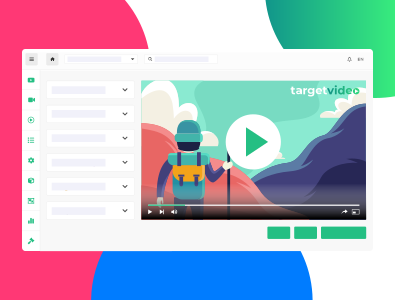
Full Control Over Monetization
The Most Advanced Ad Tech
Multi-Role Library Management
OTT Apps for All Channels
Smooth Live Streaming
And More!
OTT Monetization FAQ
1. What is OTT?
OTT (Over-the-Top) refers to the delivery of video content over the internet without requiring users to subscribe to traditional cable or satellite TV services. It allows viewers to access content on various devices, including smart TVs, mobile phones, tablets, and streaming devices.
2. What is an OTT platform?
An OTT platform is a service or software solution that enables content providers to distribute video content directly to consumers over the internet. Examples include Netflix, Hulu, and Disney+, as well as white-label solutions that allow businesses to create their own branded streaming services.
3. How to monetize OTT?
You can monetize your OTT app through various models: AVOD (video advertising), SVOD (subscriptions), TVOD (pay-per-view and transactions), Hybrid (combining two or more of the models), and FAST.
4. What is OTT advertising?
OTT advertising refers to video ads delivered via OTT platforms to viewers streaming content on OTT streaming platforms.


